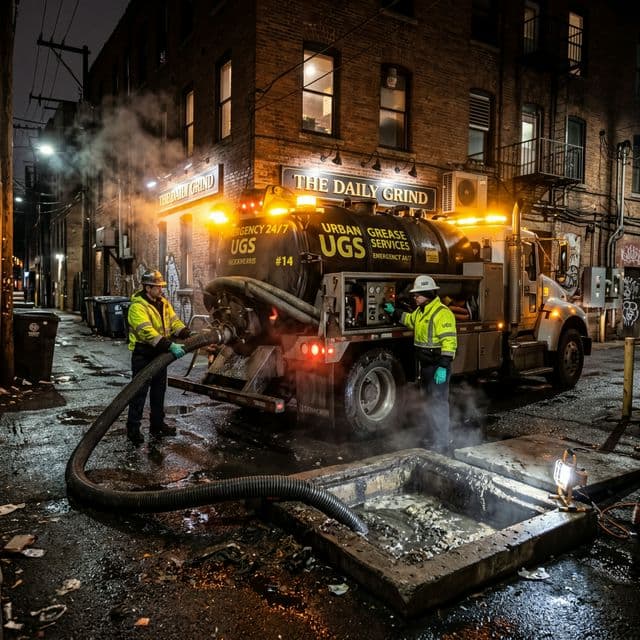
Managing a fleet of vacuum trucks using spreadsheets leads to chaotic routing, dropped clients, and severe compliance failures. When dispatchers manually attempt to balance interceptor capacities with municipal reporting deadlines, human error is inevitable. DispatchNode provides an AI-native compliance engine that completely automates dispatching, generating mathematically perfect routes and flawless digital manifests that guarantee total FOG compliance for every client.
The Dispatching Bottleneck
The profitability of a pumping operation is severely bottlenecked by the dispatcher's ability to manually group jobs into efficient daily routes. DispatchNode shatters this bottleneck by utilizing an AI routing algorithm that analyzes live traffic data, truck tank capacities, and strict municipal compliance dates to automatically generate hyper-efficient routes that maximize the volume of FOG pumped per shift.
A dispatcher relying on a whiteboard must balance a staggering number of variables. They must know exactly when a specific restaurant's trap is due for service to avoid a municipal fine, verify that the assigned truck has sufficient vacuum capacity to handle the job, and sequence the stops to minimize cross-town driving. Doing this manually for hundreds of clients results in massive operational inefficiencies and wasted diesel fuel.
The AI software ingests all these variables instantly. It groups upcoming compliance deadlines by geographic zones and assigns them to the optimal driver. If a massive two-thousand-gallon interceptor is scheduled, the system ensures that an empty truck is assigned to that route, preventing the driver from arriving at the site only to realize their tank is already full from previous stops.
By automating the complex mathematics of route density, the platform frees the dispatcher to focus on high-level fleet management and customer service. The daily manifests are pushed directly to the drivers' mobile applications, complete with turn-by-turn navigation and specific site access instructions, ensuring the field execution is as flawless as the strategic planning.
Automating the Twenty-Five Percent Rule
Municipalities aggressively enforce the twenty-five percent rule, requiring grease traps to be pumped before solids and FOG exceed a quarter of the total capacity. DispatchNode tracks historical pumping volumes to predict the exact date an interceptor will reach this critical threshold, automatically triggering a dispatch work order and completely removing the burden of schedule management from the restaurant owner.
Commercial kitchens produce grease at vastly different rates depending on their menu and volume. A fast-food fried chicken franchise will hit twenty-five percent capacity drastically faster than a high-end sushi restaurant, even if they have identically sized interceptors. Relying on a rigid, generic quarterly schedule guarantees that high-volume producers will violate compliance standards between pumps.
The software builds a customized predictive model for every single asset in the portfolio. When a driver enters the extracted volume into the mobile app, the system analyzes the data against the elapsed time since the previous service. It then dynamically adjusts the recurring schedule, pulling the next service date forward if the trap is accumulating grease faster than anticipated.
This predictive automation is the ultimate value proposition for the pumping operator. They can guarantee to the restaurant manager that the trap will never overflow and never fail an inspection. This level of proactive service locks the client into a long-term contract and completely isolates the business from low-priced, reactive competitors who lack predictive capabilities.
Smooth Digital Manifesting
Failing to provide a proper manifest after a pump-out exposes the restaurant to massive fines and damages the operator's credibility. DispatchNode digitizes the entire manifesting process, requiring the driver to input precise volumetric data into the mobile app before closing the job, instantly generating a municipal-grade PDF manifest that is emailed to the client.
Paper manifests are the bane of the service industry. Drivers routinely lose them, spill coffee on them, or submit handwriting that the accounting department cannot decipher. This leads to delayed billing and missing compliance data. The digital workflow enforces strict data validation in the field; the driver cannot swipe to complete the job unless all required fields are populated.
The system automatically populates the manifest with the restaurant's legal entity information, the pumping company's license numbers, and the exact GPS coordinates and timestamps of the service. This creates an immutable digital record that satisfies the most aggressive municipal health inspectors.
Furthermore, these digital records are aggregated into a secure online portal accessible by the client. If an inspector arrives unannounced, the restaurant manager does not need to dig through filing cabinets; they simply log into the portal on their phone and present a perfectly organized history of all pumping services, demonstrating total control over their FOG compliance.
Scaling the Operation
An operation reliant on manual dispatching and paper manifesting can only grow until the office staff collapses under the administrative weight. DispatchNode provides the technological infrastructure required to scale a pumping business infinitely, allowing operators to onboard hundreds of new commercial clients without increasing their back-office headcount or sacrificing service quality.
When the core operational loops—scheduling, routing, manifesting, and billing—are fully automated by AI, the business owner can focus entirely on strategic growth. The software smoothly integrates new contracts into existing routes, automatically balancing the load across the fleet and highlighting exactly when the purchase of an additional vacuum truck is mathematically justified.
The platform also provides deep analytics on route profitability. The dashboard reveals the true cost-per-gallon pumped, identifying low-margin routes or problematic clients who require excessive time on site. This data empowers the operator to raise prices strategically or drop unprofitable accounts, ensuring that the business scales not just in revenue, but in true bottom-line profitability.
Ultimately, specialized FOG compliance software transforms a chaotic, labor-intensive pumping business into a highly streamlined logistics operation. By leveraging AI to manage the extreme regulatory complexity of the grease trap industry, operators establish total dominance in their local markets, securing the largest, most lucrative commercial contracts available.
Operational Benchmarks for FOG compliance software automation
| Metric | Industry Average | Best-in-Class Target | Impact |
|---|---|---|---|
| Response Time | 4-8 hours | Under 90 minutes | Captures premium emergency revenue |
| First-Call Resolution | 65% | 92%+ | Eliminates costly return visits |
| Route Efficiency | 4-5 stops/day | 7-9 stops/day | Maximizes technician productivity |
| Contract Retention | 70% annual | 94%+ annual | Compounds recurring revenue |
The EPA provides regulatory guidelines that directly impact operational benchmarks for grease trap service companies. Meeting these benchmarks consistently requires purpose-built dispatch software, not generic field service tools.
Automated Service Workflow
The automation eliminates manual coordination overhead, allowing the dispatcher to focus on exception handling rather than routine scheduling.
Best Practices
- Proactive Scheduling: Use AI-predicted pump cycles based on historical grease accumulation data rather than fixed calendar intervals.
- Digital Documentation: Generate digital manifests and compliance reports automatically after every service visit.
- Customer Communication: Send automated service reminders and completion confirmations via SMS.
- Performance Tracking: Monitor technician efficiency metrics including stops per day, average service time, and customer satisfaction scores.
- Regulatory Compliance: Maintain a digital compliance database that can be exported for health department or municipal inspections on demand.
For a related analysis, read our guide on FOG Compliance Regulations.
Architectural Design of Automated FOG Manifests
The administrative bottleneck that chokes the profitability of growing grease trap pumping operations is the manual processing of compliance manifests. In a standard operation, a driver might complete eight pump-outs in a day. That represents eight handwritten, multi-part carbon copy manifests. These paper documents must be physically returned to the office, deciphered by a clerk, manually entered into an accounting system for invoicing, and then manually re-entered into a municipal compliance portal.
This redundant data entry creates a severe scaling constraint. If an operator doubles their truck fleet, they are mathematically forced to double their administrative headcount simply to handle the exponentially expanding volume of paper manifests. This administrative bloat destroys the economies of scale that should accompany fleet expansion.
Modern FOG compliance software eliminates this constraint by architecting a completely paperless, straight-through processing environment. The architecture begins at the point of service with the driver's mobile device. The software forces the driver through a rigid data collection sequence: verifying the RFID tag of the interceptor, inputting the exact gallons of FOG extracted, and securing a digital signature from the restaurant manager directly on the touchscreen.
The moment the driver hits "Submit," the software architecture forks the data packet simultaneously into three distinct automated workflows. First, the data flows into the accounting module, instantly generating a digital invoice that is emailed to the restaurant's accounts payable department, drastically reducing the Days Sales Outstanding (DSO) cycle. Second, the data updates the predictive scheduling algorithm, automatically setting the next required service date based on the volume extracted.
Third, and most critically, the data is instantly reformatted into the specific API payload required by the local municipal water authority (e.g., SwiftComply, BSI Online). The system executes an authenticated API call, pushing the verified manifest directly into the city's compliance database in real-time. This architectural design completely severs the link between fleet expansion and administrative headcount, allowing an operator to scale from five trucks to fifty without adding a single clerk to process paperwork.
Telemetry-Driven Anomaly Detection
A critical component of advanced FOG compliance software is its ability to perform automated anomaly detection, protecting both the operator and the restaurant client from regulatory sanctions. Municipalities rely heavily on historical baseline data to detect illegal dumping or improper maintenance. If a restaurant consistently produces five hundred gallons of FOG per month, and suddenly a manifest claims only one hundred gallons were extracted, the municipal algorithm flags the event for an immediate on-site inspection.
Operators who rely on manual data entry frequently trigger these municipal audits entirely by accident due to simple typographical errors made by hurried drivers or exhausted clerks. An accidental keystroke can launch a grueling regulatory investigation that disrupts the restaurant's operations and damages the operator's credibility with the city inspector.
Advanced dispatch software incorporates real-time anomaly detection at the edge—directly on the driver's mobile device—before the data is ever transmitted to the municipality. The software maintains a rolling historical average of the extraction volumes for every specific interceptor in the database. When a driver inputs the extracted volume, the system instantly compares that number against the historical baseline.
If the inputted volume deviates by more than twenty percent from the historical average, the software initiates a "hard stop" workflow. It forces the driver to acknowledge the anomaly and requires them to input a specific reason code from a drop-down menu (e.g., "Restaurant was closed for two weeks," or "Kitchen changed menu to lower-grease items"). It also mandates the capture of additional photographic evidence. By catching and documenting anomalies at the point of service, the software ensures that when the data is finally pushed to the municipal portal, it is accompanied by the necessary context to prevent an automated audit trigger, providing immense protective value to the client.
The aggregated data generated by automated compliance software provides operators with unprecedented visibility into the macro-economic trends of the local restaurant industry. By tracking the total volume of FOG extracted across hundreds of clients, the software can identify early indicators of economic shifts. For example, if the aggregate FOG extraction volume across a specific commercial district drops by fifteen percent over two consecutive quarters—despite no loss in total client count—the data strongly suggests a significant decrease in restaurant foot traffic and overall dining volume in that area. Savvy operators can utilize this macroscopic intelligence to proactively adjust their business strategies, perhaps shifting their sales focus toward expanding institutional clients (like hospitals and universities) that maintain stable volumes during retail economic downturns. This transforms the compliance software from a basic reporting tool into a strategic radar system for the entire enterprise.
The integration between FOG compliance databases and municipal reporting portals eliminates the manual data entry that previously consumed hours of administrative time each month. Direct API connections to city systems ensure that compliance reports are submitted accurately and on time without human intervention.