Performing a "pump and run" without scraping the baffles or inspecting the plumbing guarantees a rapid grease trap failure and furious client callbacks. Operators lose highly lucrative contracts when lazy technicians cut corners in the field. DispatchNode enforces rigorous service quality by pushing automated, mandatory procedure checklists to the driver's mobile app, ensuring every trap is cleaned to exacting municipal standards.
The Necessity of a Full Evacuation
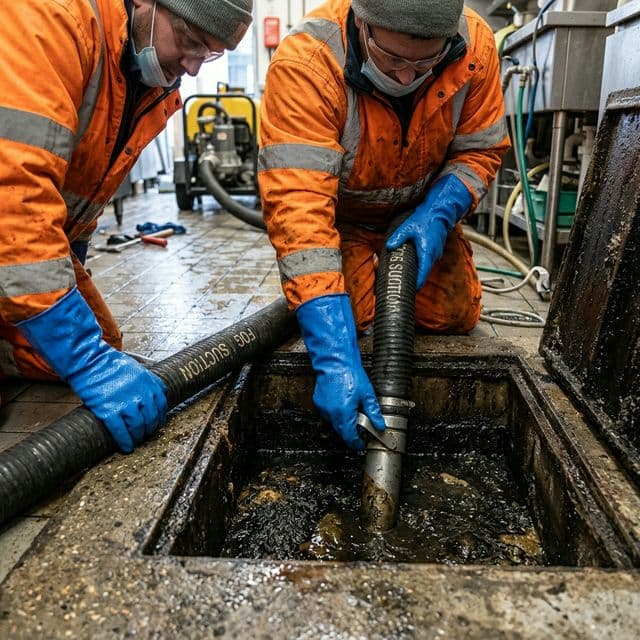
A proper pump-out requires the complete evacuation of all liquids, FOG, and settled solids; skimming the top layer is unacceptable and illegal. DispatchNode forces technicians to input the exact volume extracted into the mobile app, comparing it against the known capacity of the trap to verify that a full evacuation was performed before allowing the driver to close the work order.
Many commercial grease traps contain hundreds or thousands of gallons of waste. When an inexperienced or rushed driver arrives on site, they may simply lower the vacuum hose until they stop seeing heavy grease, leaving a massive layer of compacted food solids at the bottom of the tank. This severely reduces the effective capacity of the trap, causing it to fail well before its next scheduled service date.
The AI platform eliminates this operational failure point. The system knows the exact dimensions and capacity of every asset in the portfolio. If a driver is assigned a one-thousand-gallon interceptor and only inputs four hundred gallons extracted, the app immediately flags an anomaly. The dispatcher is alerted in real-time, allowing them to question the driver before the truck leaves the job site.
This strict enforcement protects the reputation of the pumping company. By guaranteeing a full evacuation on every service, the operator ensures that the restaurant remains fully compliant with the twenty-five percent rule and experiences zero foul odors or backups between scheduled maintenance visits.
Scraping and Inspecting the Baffles
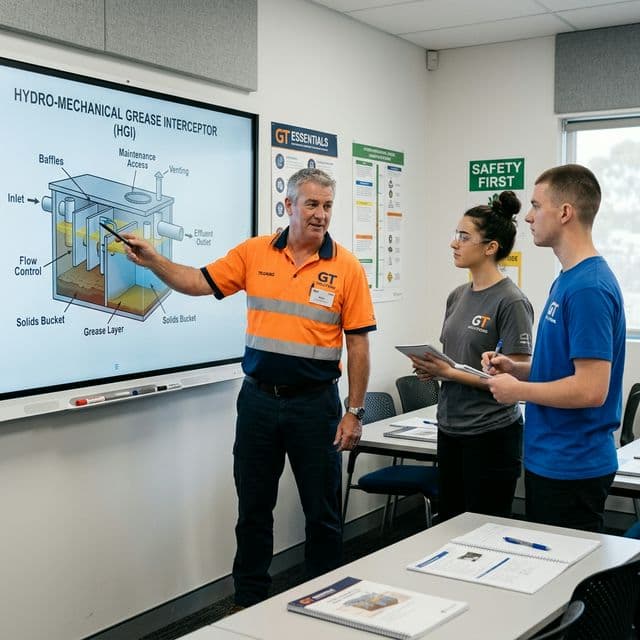
The baffles inside a grease interceptor are critical for slowing the flow of wastewater and allowing grease to separate; if they are caked in hardened FOG or structurally compromised, the trap fails entirely. DispatchNode requires the technician to physically check off a "Baffles Scraped and Inspected" task on their digital manifest, creating accountability and providing a record of structural integrity.
Vacuuming the liquid is the easy part of the job; the hard physical labor is using a heavy steel scraper to remove hardened, calcified grease from the walls and baffles of the concrete interceptor. If this hardened grease is left behind, it rapidly reduces the holding capacity of the trap and can eventually break off, causing massive downstream blockages in the city sewer line.
The digital checklist enforces this labor. The driver cannot swipe to complete the job without certifying that the scraping was performed. Furthermore, if the driver observes that a PVC T-pipe is broken or a concrete baffle is crumbling, they are required to document the damage. They take a photograph of the broken component using their tablet and attach it directly to the work order.
This documentation serves two vital purposes. First, it completely absolves the pumping company of liability if the trap fails an inspection due to structural damage. Second, it generates an immediate upsell opportunity. The system automatically emails the damage report and photographic evidence to the restaurant owner, allowing the pumping company to quote a highly profitable repair job.
Testing the Flow and Sealing the Lid
A service is not complete until the technician verifies proper water flow from the kitchen and secures the heavy manhole cover to prevent catastrophic accidents. DispatchNode includes these final verification steps in the mandatory mobile checklist, ensuring that no truck leaves a site with a blocked inlet pipe or a dangerously unsecured lid.
After the trap is fully evacuated and scraped, the technician must instruct the kitchen staff to run a high volume of water down the primary sinks. This tests the inlet line for any hidden blockages. If the water flows freely into the trap and exits properly through the outlet, the system is functioning correctly. If the flow is restricted, the technician must perform hydro-jetting to clear the line.
The system prompts the driver to confirm the flow test. The final, and arguably most important safety step, is replacing the heavy cast-iron or concrete lids. An unsecured grease trap lid in a restaurant parking lot is a massive liability; a pedestrian falling into an open interceptor results in catastrophic lawsuits.
The driver must digitally sign off that the lids have been replaced, seated correctly, and bolted down if required. This digital signature provides the business owner with peace of mind, knowing that a strict, standardized safety protocol was followed by every driver, on every route, every single day.
Automating the Service Record
Executing the perfect pump-out in the field must be paired with flawless documentation to satisfy municipal health inspectors. DispatchNode captures all data from the driver's mandatory checklist and instantly generates a comprehensive digital manifest, providing the restaurant with undeniable proof that their trap was serviced to the highest possible standard.
The final PDF manifest generated by the software goes far beyond a simple receipt. It details the exact time of arrival, the total volume evacuated, the condition of the baffles, the results of the flow test, and the driver's signature. This document is a powerful shield against aggressive municipal auditors.
When a health inspector demands proof of compliance, the restaurant manager does not have to explain the nuances of the pump-out procedure. They simply hand over the DispatchNode digital manifest. The extreme level of detail proves that the pumping company is a highly professional operation that adheres to strict environmental standards.
By utilizing software to enforce and document the step-by-step pump-out procedure, grease trap operators elevate their service quality across the entire fleet. They eliminate the risk of "pump and run" lazy technicians, protect their clients from compliance fines, and establish a reputation for absolute reliability that allows them to dominate the commercial market.
Operational Benchmarks for Pump-out procedures and best practices
| Metric | Industry Average | Best-in-Class Target | Impact |
|---|---|---|---|
| Response Time | 4-8 hours | Under 90 minutes | Captures premium emergency revenue |
| First-Call Resolution | 65% | 92%+ | Eliminates costly return visits |
| Route Efficiency | 4-5 stops/day | 7-9 stops/day | Maximizes technician productivity |
| Contract Retention | 70% annual | 94%+ annual | Compounds recurring revenue |
The EPA provides regulatory guidelines that directly impact operational benchmarks for grease trap service companies. Meeting these benchmarks consistently requires purpose-built dispatch software, not generic field service tools.
Automated Service Workflow
The automation eliminates manual coordination overhead, allowing the dispatcher to focus on exception handling rather than routine scheduling.
Best Practices
- Proactive Scheduling: Use AI-predicted pump cycles based on historical grease accumulation data rather than fixed calendar intervals.
- Digital Documentation: Generate digital manifests and compliance reports automatically after every service visit.
- Customer Communication: Send automated service reminders and completion confirmations via SMS.
- Performance Tracking: Monitor technician efficiency metrics including stops per day, average service time, and customer satisfaction scores.
- Regulatory Compliance: Maintain a digital compliance database that can be exported for health department or municipal inspections on demand.
For a related analysis, read our guide on Grease Trap Sizing and Interceptor Capacity.
Hydro-Mechanical Extraction Tolerances
The physical process of emptying a grease interceptor is frequently misunderstood by novice operators and restaurant owners alike as a simple vacuum procedure. In reality, a proper pump-out is a complex hydro-mechanical extraction requiring precision equipment tolerances and highly trained technicians. A commercial grease trap functions by utilizing the specific gravity differential between water and FOG (Fats, Oils, and Grease). As wastewater enters the baffle system, the heavier food solids sink to the bottom, while the lighter FOG congeals into a thick, hardened cap floating on the surface, allowing the clearer gray water in the middle to pass into the municipal sewer.
Over a ninety-day cycle, the floating FOG cap can harden into a semi-solid mass possessing the consistency of dense clay, sometimes exceeding twelve inches in thickness. If a technician simply drops a vacuum hose into the center of the trap, the suction will easily remove the liquid gray water but will merely bore a localized hole through the hardened grease cap, leaving the vast majority of the FOG adhered to the concrete walls of the interceptor. This improper procedure, known industry-wide as "short-pumping," is the primary cause of catastrophic sanitary sewer overflows (SSOs).
Executing a compliant pump-out requires the technician to actively manage the hydro-mechanical breakdown of the FOG cap. The technician must utilize the "pump and return" method, utilizing the vacuum truck's pressurized backflush capability. By drawing liquid into the truck and then forcefully jetting it back into the interceptor at high pressure, the technician creates massive hydraulic turbulence. This turbulence fractures the hardened FOG cap, shearing it away from the concrete walls and emulsifying it into a slurry that the vacuum hose can effectively extract.
This procedure places immense strain on the vacuum truck's Power Take-Off (PTO) system and rotary vane pump. Operators must strictly monitor the operational hours of these components using advanced fleet telematics. Attempting to extract hardened grease with a degraded vacuum pump that cannot maintain optimal negative pressure guarantees an incomplete pump-out. The dispatch software must track the exact duration of the extraction phase for every service event; if the historical average for a specific one-thousand-gallon trap is forty-five minutes, but the telemetry shows the driver only ran the PTO for fifteen minutes, the software automatically flags the event for managerial review, catching the short-pumping behavior before the municipality detects it.
The Chemistry of Bioremediation and Chemical Dosing
Following the complete hydro-mechanical extraction of the FOG and settled solids, the technician's focus must shift to the biological stabilization of the newly emptied interceptor. Scraping the concrete walls clean exposes microscopic pores that harbor anaerobic bacteria. If left untreated, these bacteria will rapidly multiply, generating massive quantities of hydrogen sulfide gas. This gas not only creates the putrid odor associated with grease traps but also mixes with ambient moisture to form sulfuric acid, which rapidly corrodes the concrete structure of the interceptor, ultimately causing a catastrophic collapse.
To prevent this, the final step in a rigorous pump-out procedure involves precise chemical dosing and bioremediation. This is not a matter of simply dumping a gallon of bleach into the tank—a practice that is universally illegal as it destroys the beneficial bacteria required at the municipal wastewater treatment facility downstream.
Instead, technicians must introduce specialized, enzyme-producing bacterial cultures specifically engineered to metabolize residual FOG. These vegetative bacteria colonies establish themselves on the walls of the interceptor and within the baffle system. As new grease enters the trap during daily kitchen operations, these bacteria begin breaking down the long-chain lipid molecules before they can congeal into a hardened mass.
The efficacy of this bioremediation is highly dependent on precise dosing calibration. Advanced dispatch software integrates the chemical dosing requirements directly into the driver's manifest. The algorithm calculates the exact required volume of the bacterial additive based on the total volumetric capacity of the specific interceptor and the ambient seasonal temperature (as bacterial replication rates fluctuate with heat). The driver must digitally confirm the application of the specific dosage before the software allows them to close the work order. This algorithmic control ensures consistent biological management across the entire fleet, drastically reducing odor complaints and protecting the structural integrity of the clients' expensive underground assets.
The physical execution of the pump-out procedure is inherently dangerous, exposing technicians to confined space hazards, toxic gases, and heavy machinery risks. Advanced dispatch software integrates mandatory safety protocols directly into the execution workflow to mitigate these liabilities. Before a technician is permitted to engage the PTO and begin the extraction, the mobile application forces them to complete a digital Job Safety Analysis (JSA). This includes verifying the placement of traffic cones, confirming the atmospheric monitor is active (to detect deadly hydrogen sulfide levels), and documenting the exact location of the nearest emergency water shutoff valve. The technician must electronically sign the JSA on the tablet, creating an immutable record of compliance with OSHA safety standards. If a workplace injury does occur, the operator possesses irrefutable digital proof that all required safety protocols were mandated and acknowledged prior to the commencement of work, drastically reducing the severity of subsequent regulatory investigations.