Relying on a dispatcher's intuition to route a heavy vacuum truck guarantees massive diesel waste and destroyed profit margins. When drivers zig-zag across the city pumping randomly assigned grease traps, they spend more time in traffic than actively extracting FOG. DispatchNode deploys a mathematically rigorous AI routing engine that clusters jobs by strict geographic zones, ensuring your trucks pump the absolute maximum volume of grease per mile driven.
The Physics of Vacuum Truck Routing
Routing a massive vacuum truck requires calculating variables that standard mapping applications completely ignore, such as fluctuating tank capacity and gross vehicle weight restrictions. DispatchNode analyzes the precise gallon capacity of every assigned truck and builds routes that maximize extraction volume without forcing the driver into illegal weight classes or requiring highly inefficient mid-day disposal runs.
Standard GPS routing assumes an empty, lightweight vehicle. A vacuum truck fully loaded with three thousand gallons of water and dense FOG operates under entirely different physical constraints. Driving a fully loaded tanker across the city to reach a municipal disposal facility is incredibly expensive in terms of fuel consumption and wear on the heavy-duty braking systems.
The AI routing platform eliminates this inefficiency by optimizing the dump cycle. It sequences the daily manifest so that the final, largest commercial interceptor pump-out is geographically proximate to the authorized municipal wastewater treatment plant. This ensures the truck achieves maximum capacity immediately before disposal, completely eliminating the deadhead miles associated with driving a full tank across town.
Furthermore, the system strictly enforces geographic service zones. It refuses to allow a dispatcher to schedule a single, low-volume residential grease trap pump-out on the far side of the city unless a massive premium fee is attached to the invoice. By maintaining strict zone discipline, the operator guarantees that every mile driven is generating maximum revenue.
Dynamic Recalibration During the Shift
A perfectly planned route shatters the moment a driver encounters gridlock traffic or is dispatched to an emergency restaurant backup. DispatchNode provides an elastic routing matrix that dynamically recalibrates the entire daily manifest in real-time based on live traffic data and emergency injections, guaranteeing the driver completes the maximum number of stops safely before their shift expires.
When a massive accident shuts down an interstate, a driver relying on a paper route sheet is paralyzed. They are stuck in traffic, bleeding expensive hourly labor, while the restaurants scheduled for the remainder of the day are left unserviced. The dispatcher in the office is completely blind to the severity of the delay until the furious clients start calling.
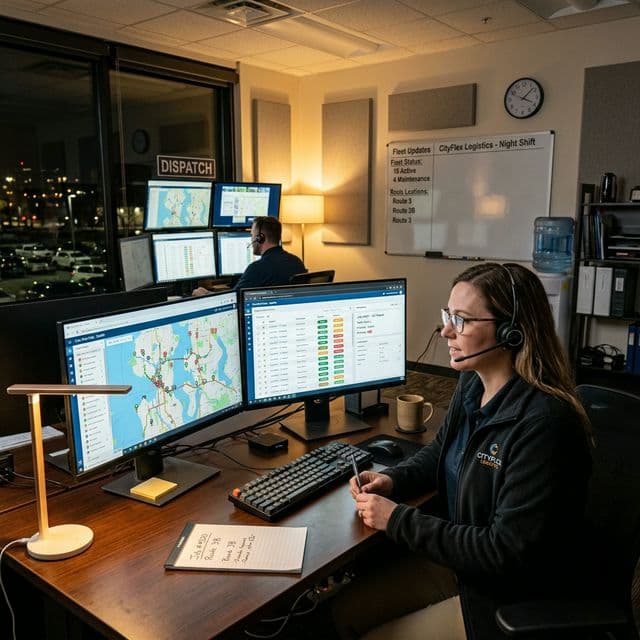
The AI platform constantly monitors the live GPS position of the truck against real-time municipal traffic APIs. If the software detects a severe delay on the projected path, it instantly calculates a detour. If the delay makes it impossible for the driver to complete the final stops on their manifest within legal operating hours, the system automatically offloads those specific jobs to another truck operating in an adjacent, unaffected zone.
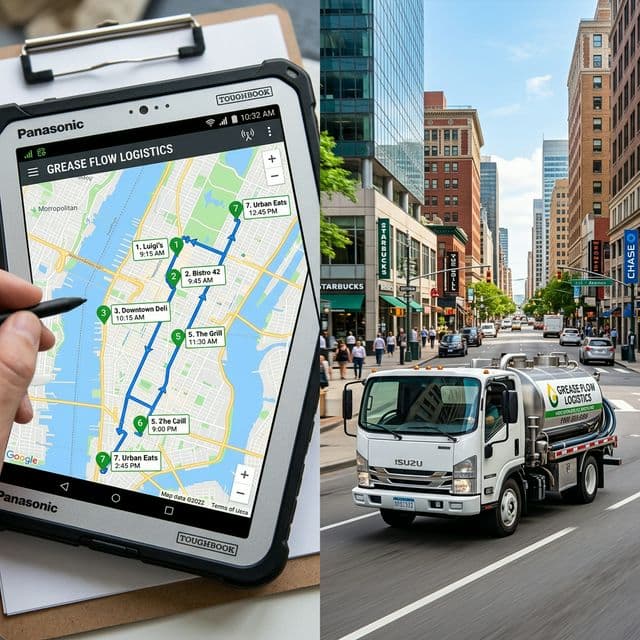
This dynamic load-balancing happens autonomously in the background. The drivers simply follow the updated turn-by-turn navigation on their mobile tablets. The system also automatically transmits SMS updates to the affected clients, adjusting their expected service window and maintaining total transparency without requiring the dispatcher to make dozens of frantic phone calls.
Predictive Maintenance Routing
Route density is the holy grail of the pumping industry, and it can only be achieved through predictive, highly localized maintenance scheduling. DispatchNode analyzes the historical FOG accumulation rates of all clients in a specific geographic cluster, automatically aligning their compliance schedules to trigger simultaneously, creating hyper-dense, massively profitable routing days.
If an operator has ten restaurants located in a single outdoor strip mall, servicing them on ten different days throughout the month destroys the profit margin of those contracts. The AI engine recognizes the geographic proximity of these assets. Even if their traps accumulate grease at slightly different rates, the software calculates the optimal median date to service all ten traps simultaneously.
The system automatically generates a proposal to the restaurant managers: "We are establishing a dedicated service day for your commercial center on the 15th of every month. By aligning your schedule, we can offer a fifteen percent reduction in your pumping rate while guaranteeing perfect FOG compliance." The restaurants immediately accept the discount, and the operator secures a route density that is practically unbeatable by competitors.
This predictive clustering transforms route planning from a daily struggle into a long-term strategic advantage. The operator can literally purchase a new vacuum truck and immediately assign it a mathematically perfect, fully loaded route that generates positive cash flow from day one, rather than slowly building route density over months of inefficient, scattered service calls.
Measuring Profit Per Mile
You cannot optimize what you do not measure; operators relying on intuition have no idea which routes are actually generating profit and which are operating at a loss. DispatchNode provides a comprehensive financial dashboard that calculates the exact profit per mile driven for every single route, exposing severe operational inefficiencies and empowering the owner to make data-driven pricing adjustments.
The dashboard correlates the total revenue generated by the daily manifest against the specific costs of execution: diesel fuel consumed, hourly labor paid to the driver, and municipal tipping fees. It reveals the harsh truth about legacy routing habits. A route that the dispatcher considered "busy" might actually be losing money because it requires excessive cross-town driving for low-volume traps.
Armed with this data, the business owner can execute precise surgical adjustments to their pricing model. If a specific geographic zone consistently yields a negative profit-per-mile, the operator has two choices: increase the route density by aggressively marketing to restaurants in that specific area, or instantly raise the base pumping rate for all clients in that zone to offset the logistical costs.
By treating the vacuum truck fleet as a highly sophisticated logistics network rather than a collection of glorified waste haulers, operators utilizing AI routing platforms achieve massive financial superiority. They cut their fuel expenditures, maximize their labor utilization, and ensure that every single gallon of FOG pumped contributes directly to the bottom line.
Operational Benchmarks for Route optimization for pump trucks
| Metric | Industry Average | Best-in-Class Target | Impact |
|---|---|---|---|
| Response Time | 4-8 hours | Under 90 minutes | Captures premium emergency revenue |
| First-Call Resolution | 65% | 92%+ | Eliminates costly return visits |
| Route Efficiency | 4-5 stops/day | 7-9 stops/day | Maximizes technician productivity |
| Contract Retention | 70% annual | 94%+ annual | Compounds recurring revenue |
The DOT provides regulatory guidelines that directly impact operational benchmarks for grease trap service companies. Meeting these benchmarks consistently requires purpose-built dispatch software, not generic field service tools.
Automated Service Workflow
The automation eliminates manual coordination overhead, allowing the dispatcher to focus on exception handling rather than routine scheduling.
Best Practices
- Proactive Scheduling: Use AI-predicted pump cycles based on historical grease accumulation data rather than fixed calendar intervals.
- Digital Documentation: Generate digital manifests and compliance reports automatically after every service visit.
- Customer Communication: Send automated service reminders and completion confirmations via SMS.
- Performance Tracking: Monitor technician efficiency metrics including stops per day, average service time, and customer satisfaction scores.
- Regulatory Compliance: Maintain a digital compliance database that can be exported for health department or municipal inspections on demand.
For a related analysis, read our guide on Best Scheduling Software for Grease Trap Companies.
Spatial-Temporal Optimization Algorithms
Traditional route planning in the commercial liquid waste industry relies heavily on geographic proximity—grouping stops that are close together on a map. While this is a logical starting point, it fails to account for the temporal realities of urban commercial environments. A restaurant might be geographically located next door to another active client, but if the first restaurant requires service before 9:00 AM due to municipal parking restrictions, and the second restaurant cannot be accessed until after 2:00 PM because the interceptor is located under a delivery loading dock, geographic proximity is rendered completely useless.
Advanced dispatch algorithms solve this through spatial-temporal optimization. The software does not merely map locations; it maps "service windows." When establishing a contract, the operator inputs strict temporal constraints into the database for every specific interceptor. The algorithm then runs thousands of permutations to find a route that satisfies all geographic efficiencies without violating any temporal constraints.
This optimization becomes exponentially more complex when factoring in the specific physics of a vacuum pump truck. Unlike a standard delivery vehicle that gets lighter throughout the day, a pump truck gets progressively heavier, drastically altering its fuel efficiency, braking distance, and legal road-weight compliance. The algorithm must calculate the projected volumetric extraction at each stop.
If a route includes a massive three-thousand-gallon interceptor at a hotel complex and four smaller five-hundred-gallon traps at fast-food restaurants, the software will algorithmically sequence the route to ensure the truck services the smaller traps first, minimizing the time the vehicle spends operating at maximum gross vehicle weight. This spatial-temporal sequencing drastically reduces fuel consumption and mechanical wear on the transmission and suspension systems, translating algorithmic efficiency directly into hard capital savings.
Dynamic Rescheduling and Traffic Ingestion
The most perfectly optimized morning route plan rarely survives contact with the reality of mid-day urban traffic. A severe accident on a major arterial highway or unexpected construction can instantly introduce a two-hour delay, destroying the spatial-temporal sequence and causing the driver to miss critical service windows, angering commercial clients and potentially triggering compliance violations.
Legacy routing systems are static; once the manifest is printed and handed to the driver, it cannot adapt. Modern AI-driven dispatch platforms are intensely dynamic. They continuously ingest real-time traffic telemetry via APIs (such as Google Maps or Waze Enterprise) and cross-reference the live GPS location of the pump truck against the remaining scheduled stops.
If the software detects a sudden fifty-minute traffic delay on the driver's current path, it does not passively wait for the driver to get stuck. The AI instantly executes a rapid recalculation protocol. It identifies an alternative client within the driver's immediate, unimpeded geographic radius who is due for a preventative maintenance pump-out within the next three days.
The system then pushes a dynamic route update directly to the driver's mobile tablet, complete with an audible alert, rerouting them to the newly inserted stop to ensure they remain productive while the highway traffic clears. Simultaneously, the system sends an automated, polite SMS notification to the original client, informing them of the delay and providing an updated, highly accurate ETA based on the live traffic data. This dynamic elasticity ensures that unavoidable external delays do not result in a catastrophic loss of daily revenue generation, maintaining the financial velocity of the fleet regardless of urban chaos.
The strategic utilization of verified Scope 3 emissions data transforms route optimization into a potent commercial asset. Operators who provide this critical environmental reporting mathematically position themselves to win exclusive, multi-year contracts with the most lucrative, sustainability-focused corporate restaurant franchises in their regional market.
The Carbon Efficiency Report serves as a highly potent tool for securing contracts with publicly traded restaurant corporations. These massive entities face intense pressure from institutional investors to document and reduce their Scope 3 supply chain emissions. A FOG operator who can natively provide this granular, verified emissions data via their dispatch software instantly bypasses smaller, less sophisticated competitors in the corporate procurement process.
The environmental implications of spatial-temporal optimization extend far beyond simple fuel savings; they directly impact the operator's ability to win lucrative sustainability-focused corporate contracts. Massive multi-national restaurant chains are increasingly implementing strict "Scope 3" emissions reporting requirements for all their vendors. An operator relying on manual dispatching cannot accurately quantify the carbon footprint of their service routes. DispatchNode's algorithmic routing engine automatically generates a "Carbon Efficiency Report" for every commercial client. This report mathematically demonstrates how the operator's optimized routing reduced total diesel consumption and associated greenhouse gas emissions compared to standard routing baselines. By providing this highly structured environmental data, the FOG operator instantly satisfies the corporate client's sustainability mandates, transforming route efficiency from an internal cost-saving measure into a powerful, revenue-generating competitive advantage.