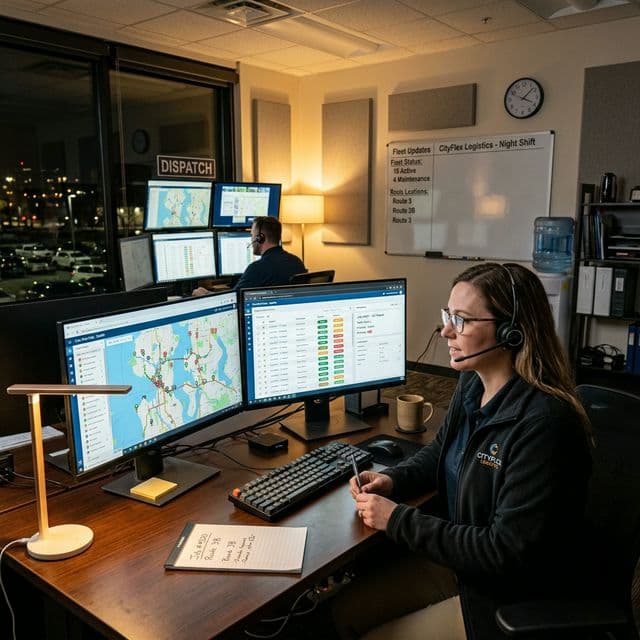
Hiring a generic answering service to manage emergency plumbing calls is a massive operational liability. Call center representatives reading from a script cannot calculate FOG compliance dates, quote dynamic emergency rates, or route a vacuum truck. GreaseTrapDispatch replaces incompetent human operators with a highly specialized AI voice agent that instantly triages emergencies, secures upfront payments, and integrates directly with your routing algorithm.
The Incompetence of Generic Scripts
A backed-up commercial kitchen requires immediate, intelligent triage, not a polite message-taker. GreaseTrapDispatch provides an AI agent trained extensively on commercial plumbing and FOG terminology, capable of distinguishing between a standard compliance inquiry and a catastrophic interceptor failure, whereas traditional answering services simply transcribe panicked voicemails and page the operator.
When a restaurant manager calls at midnight because their kitchen is flooding with raw grease, they need immediate reassurance and a definitive ETA. A generic call center agent in a different time zone has no visibility into the local fleet's location or the specific size of the client's grease trap. The caller is forced to explain their entire account history to someone who does not understand what a baffle is.
The AI voice agent eliminates this friction. Because it is directly tied to the client database, it recognizes the caller's phone number instantly. It answers the phone with complete context: "Hello, this is GreaseTrapDispatch. Are you calling regarding the one-thousand-gallon interceptor at your downtown location?" This immediate demonstration of competence calms the panicked client and asserts the professionalism of the pumping operator.
Furthermore, generic answering services operate on static scripts. If a caller asks a question slightly outside the script's parameters, the human agent freezes, resulting in long holds and frustrated customers. The AI agent utilizes advanced natural language processing to handle highly complex, multi-variable questions smoothly, ensuring every inbound lead is captured and converted into a work order.
Dynamic Quoting and Payment Collection
Answering services cannot securely collect payments or quote dynamic pricing based on route density. GreaseTrapDispatch empowers the AI agent to calculate exact pumping rates based on trap size, apply after-hours emergency surcharges, and securely collect credit card deposits via SMS during the phone call, securing revenue before the truck ever leaves the yard.
Operators lose thousands of dollars relying on answering services to relay emergency requests. By the time the business owner wakes up, checks the pager message, and calls the restaurant back to negotiate a price, the restaurant has already called a competitor who answered the phone directly. The speed of the quote determines who wins the highly lucrative emergency contract.
The AI agent processes the quote instantly. If the call occurs at 2:00 AM, the system automatically injects a three-hundred-dollar emergency premium into the standard volumetric rate. The agent clearly explains the pricing to the caller and refuses to dispatch the truck until the premium is authorized. "I have a truck available in thirty minutes. The emergency response fee is seven hundred dollars. Shall I send a secure payment link to confirm?"
This capability transforms the phone lines from a simple message-taking apparatus into an aggressive, autonomous sales engine. The operator wakes up to find fully funded work orders already injected into the daily manifest. They never have to chase down a restaurant manager to collect on an emergency invoice because the AI secured the funds upfront.
Direct Routing Integration
Taking a message requires a secondary action: someone must manually enter that message into a routing software. GreaseTrapDispatch eliminates this administrative redundancy by instantly converting the AI's conversation data into a structured work order and injecting it directly into the optimal driver's route manifest, completely bypassing human data entry.
When an answering service emails a transcript of a call to the dispatcher, the dispatcher must read the email, manually type the address into Google Maps, determine which truck is closest, and text the driver. Every step in this manual chain is a potential failure point. A single typo in the address transcription wastes hours of the driver's time and destroys the profitability of the route.
The AI agent validates the address automatically during the phone call. It checks the live GPS coordinates of the fleet and identifies the truck with the necessary remaining tank capacity to handle the job. The resulting work order is mathematically flawless.
This smooth integration between the initial phone call and the final field execution is the core value proposition of an AI-native platform. It allows a pumping company to operate twenty-four hours a day without requiring a human dispatcher to be awake, dramatically reducing overhead costs while significantly increasing total fleet efficiency and revenue.
Cost Analysis: AI vs. Call Centers
Traditional answering services charge exorbitant per-minute rates, penalizing the operator for every second a customer spends on hold. GreaseTrapDispatch provides a flat-rate, infinitely scalable AI agent that handles unlimited concurrent calls, drastically reducing monthly telecommunications overhead while delivering a vastly superior client experience.
Call centers operate on a fundamental conflict of interest. They are incentivized to keep callers on the phone as long as possible to maximize their per-minute billing. During a massive weather event or regional emergency, inbound call volume spikes. Operators utilizing traditional services are hit with massive, unexpected bills precisely when their own operations are most chaotic.
The AI agent does not bill by the minute, and it never places a customer on hold. If fifty restaurants call simultaneously with flooded traps, the AI answers all fifty calls instantly. This absolute scalability ensures that zero high-margin emergency leads are lost to voicemail or busy signals.
By replacing the outdated, highly expensive human call center model with a deeply integrated AI voice agent, grease trap pumping companies cut their administrative overhead while significantly increasing their operational responsiveness. This technological upgrade is mandatory for operators seeking to dominate the commercial compliance market.
Operational Benchmarks for AI dispatch vs generic answering services
| Metric | Industry Average | Best-in-Class Target | Impact |
|---|---|---|---|
| Response Time | 4-8 hours | Under 90 minutes | Captures premium emergency revenue |
| First-Call Resolution | 65% | 92%+ | Eliminates costly return visits |
| Route Efficiency | 4-5 stops/day | 7-9 stops/day | Maximizes technician productivity |
| Contract Retention | 70% annual | 94%+ annual | Compounds recurring revenue |
The SBA provides regulatory guidelines that directly impact operational benchmarks for grease trap service companies. Meeting these benchmarks consistently requires purpose-built dispatch software, not generic field service tools.
Automated Service Workflow
The automation eliminates manual coordination overhead, allowing the dispatcher to focus on exception handling rather than routine scheduling.
Best Practices
- Proactive Scheduling: Use AI-predicted pump cycles based on historical grease accumulation data rather than fixed calendar intervals.
- Digital Documentation: Generate digital manifests and compliance reports automatically after every service visit.
- Customer Communication: Send automated service reminders and completion confirmations via SMS.
- Performance Tracking: Monitor technician efficiency metrics including stops per day, average service time, and customer satisfaction scores.
- Regulatory Compliance: Maintain a digital compliance database that can be exported for health department or municipal inspections on demand.
For a related analysis, read our guide on AI Emergency Grease Trap Service Calls.
The Necessity of Domain-Specific AI Architecture
The fundamental failure of generic answering services—whether staffed by humans or basic chatbots—when deployed in the FOG (Fats, Oils, and Grease) industry stems from a profound lack of domain-specific architectural knowledge. The portable sanitation and liquid waste industries utilize a highly specific, highly technical lexicon. When a restaurant manager calls in a panic, they do not speak in generalities; they speak in urgent technical specifics.
A restaurant manager might call and say, "The main line is backed up past the sampling tee, the baffle is compromised, and we've got a Category 3 SSO imminent in the prep kitchen." A human operator at a generic answering service, trained to handle calls for dentists and dog groomers, hears this as literal gibberish. They can only respond with, "I'm sorry, I don't understand, but I will take a message and have someone call you back." In a situation where raw sewage is threatening to shut down a business, "taking a message" is an unacceptable failure.
DispatchNode's AI voice agent is architected entirely differently. It is built upon a domain-specific Large Language Model (LLM) that has been exhaustively trained on tens of thousands of hours of actual FOG industry dispatch audio. It understands the structural components of an interceptor (baffles, sampling tees, flow restrictors). It understands the regulatory terminology (SSO, FOG limits, municipal manifests). It understands the volumetric math of vacuum trucks.
When the AI hears the panicked restaurant manager's technical description, it instantly parses the severity of the situation. It recognizes that a "Category 3 SSO" constitutes an extreme biological hazard and a municipal emergency. It immediately executes a predefined emergency protocol, bypassing standard scheduling matrices and automatically pinging the nearest high-capacity vacuum truck. This deep, domain-specific comprehension allows the AI to act as a highly trained technical dispatcher, resolving complex crises autonomously rather than acting as a simple, ineffective message relay system.
The Economic Impact of First-Call Resolution
In the highly competitive commercial liquid waste hauling market, the concept of "First-Call Resolution" (FCR) is the single most important metric driving top-line revenue growth. When a potential new commercial client—perhaps a regional facility manager for a chain of twenty fast-food restaurants—calls to inquire about establishing a preventative maintenance contract, they are evaluating the operator's competence from the very first syllable.
If their call is routed to a generic answering service, the FCR rate is mathematically zero. The answering service cannot quote complex volumetric pricing matrices, they cannot verify the operator's compliance reporting capabilities with the specific municipality, and they certainly cannot draft and execute a commercial contract. The caller is forced into a callback queue, introducing massive friction into the sales process and drastically increasing the probability that they will simply hang up and dial the next competitor on Google.
DispatchNode's AI agent drives the First-Call Resolution rate toward one hundred percent. Because the AI has complete, real-time access to the operator's pricing rules, fleet capacity, and municipal compliance databases, it can handle the entire commercial sales cycle during the initial conversation.
The AI can dynamically calculate a tiered pricing proposal for the twenty-location franchise based on tank sizes and required pump-out frequencies. It can confidently explain the operator's automated municipal reporting capabilities. Most importantly, it can instantly text a secure digital contract link to the facility manager while they are still on the phone. By achieving absolute First-Call Resolution, the AI transforms the inbound phone line from a leaky, frustrating message-taking channel into a high-velocity, closed-loop revenue generation engine. The economic delta between a zero percent FCR and a near-one-hundred percent FCR is frequently the difference between stagnation and explosive market dominance.
The polyglot AI capabilities also extend to the generation of localized SMS follow-ups. If the initial emergency call was conducted in Mandarin, the AI ensures that the post-service compliance survey and the secure payment link are automatically translated and delivered in the same language. This end-to-end linguistic consistency drastically improves client satisfaction and payment velocity among diverse demographic groups.
The implementation of conversational AI also fundamentally alters the economics of managing bilingual customer bases in diverse metropolitan areas. In regions with high concentrations of immigrant-owned restaurants, the inability to effectively communicate in Spanish, Mandarin, or Vietnamese creates massive friction in the dispatch process, frequently resulting in lost sales and compliance misunderstandings. Hiring human dispatchers fluent in multiple languages is expensive and operationally difficult to scale across a twenty-four-hour schedule. The AI voice agent inherently possesses polyglot capabilities. If a panicked restaurant owner begins speaking in Spanish, the AI instantly detects the language shift and seamlessly transitions the conversation, executing the entire emergency triage and dispatch protocol in flawless Spanish. This capability allows the operator to aggressively expand their market share into diverse commercial districts without incurring the immense payroll burden of staffing a multi-lingual, round-the-clock call center.
The financial analysis consistently demonstrates that specialized AI dispatch agents generate three to five times more revenue per inbound call than generic answering services. This revenue multiplier stems from the AI ability to quote pricing, check availability, and secure bookings during the initial conversation rather than simply recording a message for later follow-up.