Relying on a generic virtual receptionist from Smith AI to handle a catastrophic grease trap backup guarantees that your client will hang up in frustration. Human receptionists who do not understand volumetric pumping capacities or municipal FOG compliance cannot execute an emergency dispatch. GreaseTrapDispatch replaces incompetent messaging services with a highly specialized AI voice agent that instantly triages plumbing emergencies, quotes dynamic premium rates, and routes your vacuum trucks autonomously.
The Language Barrier in Commercial Plumbing
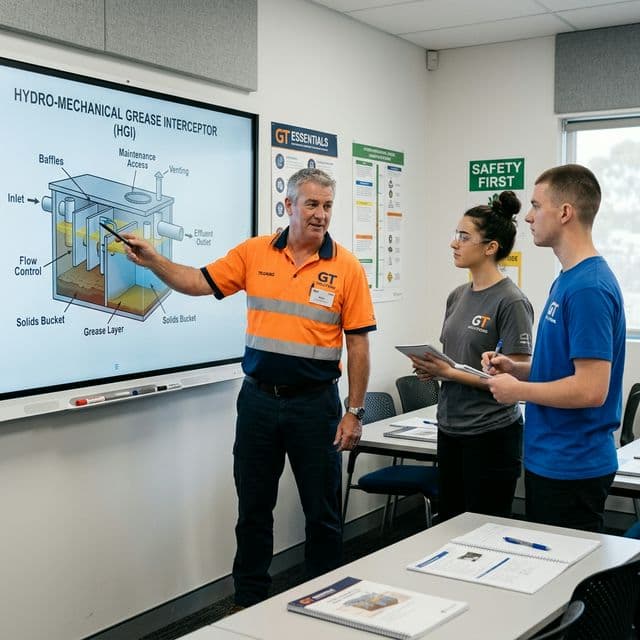
Commercial plumbing utilizes a highly specific technical lexicon; a receptionist who confuses a hydromechanical grease interceptor with a standard septic tank cannot properly serve your clients. GreaseTrapDispatch deploys an AI agent trained extensively on the specific terminology of the FOG (Fats, Oils, and Grease) industry, ensuring every inbound call is understood perfectly and the resulting work order is technically flawless.
When a restaurant manager frantically calls to report a backing-up inlet line, they need immediate, competent assistance. A generic receptionist from Smith AI must rely on a rigid script, typically asking standard administrative questions before placing the caller on hold to page the operator. In an emergency, this delay is unacceptable and frequently results in the restaurant calling a competitor who answers the phone directly.
The specialized AI agent engages the caller intelligently. It instantly cross-references the caller's phone number with the active client database, greeting them by name and verifying the location of their primary interceptor. This immediate demonstration of technical competence reassures the panicked manager that they are dealing with a highly professional plumbing logistics company.
Furthermore, if the caller requires a highly specific service, such as high-pressure hydro-jetting to clear a calcified baffle, the AI agent understands the request. It accurately categorizes the service requirement and ensures that the dispatch algorithm assigns a truck equipped with the necessary hydro-jetting hardware, preventing the costly error of sending a standard vacuum truck to a complex blockage.
The Failure of Message Taking
Taking a message does not solve a plumbing crisis. Smith AI and similar services simply transcribe the caller's problem and email it to the dispatcher. GreaseTrapDispatch completely eliminates this administrative bottleneck by instantly processing the emergency request, securing the required upfront payment, and injecting the confirmed work order directly into the driver's active route manifest.
The fatal flaw of generic reception services is that they lack direct integration with the operator's routing and pricing infrastructure. They cannot calculate the cost of an emergency dispatch based on the current geographic location of the fleet, nor can they verify if a truck actually has the necessary tank capacity to perform the requested pump-out.
The AI-native platform executes the entire workflow. When the emergency call comes in, the agent analyzes the live GPS data of the fleet. "We have a truck available in your zone. The emergency dispatch fee is three hundred dollars on top of the standard pumping rate. Shall I secure your booking with a payment link?"
Once the client authorizes the premium via the secure SMS link, the system autonomously overrides the driver's current manifest. It inserts the emergency stop, recalculates the turn-by-turn navigation, and alerts the driver via the mobile app. The business owner does not need to wake up, check an email, or make a single phone call to execute this highly lucrative transaction.
Compliance and Manifest Retrieval
When a municipal health inspector demands proof of FOG compliance, a restaurant manager cannot wait for an office manager to return an email. Smith AI cannot access your secure database to retrieve a compliance manifest. GreaseTrapDispatch empowers its AI agent to securely access the client's service history and instantly email the requested digital manifest while the inspector is still standing in the kitchen.
Municipal audits are sudden and aggressive. If a restaurant fails to produce a valid pumping manifest, they face immediate fines or operational shutdown. The pumping operator is their sole lifeline. If the operator's phone line is managed by a generic receptionist who states, "Someone will get back to you during business hours," the operator has failed their client.
The AI agent acts as an autonomous compliance officer. It verifies the caller's identity, retrieves the specific PDF manifest containing the driver's signature and the exact volumetric extraction data, and transmits it instantly. This level of immediate support solidifies the pumping operator as an indispensable compliance partner, securing the long-term contract against any competitor.
By utilizing AI to deliver instant access to critical regulatory documentation, pumping companies elevate their service offering far beyond standard waste hauling. They sell peace of mind and total protection from municipal fines, allowing them to charge premium rates in highly competitive commercial markets.
The Economics of Unlimited Scalability
Generic reception services charge operators by the minute or by the call, financially penalizing the pumping company during massive regional weather events or widespread infrastructure failures. GreaseTrapDispatch provides a flat-rate, infinitely expandable AI architecture that handles unlimited concurrent emergency calls simultaneously, guaranteeing zero clients are placed on hold and slashing telecommunications overhead.
During a severe storm that causes widespread sewer backups, a pumping company's inbound call volume can spike by a thousand percent. A traditional answering service will collapse under the volume, placing callers on interminable holds or defaulting to a generic voicemail box. The operator loses dozens of high-margin emergency jobs simply because the phone system failed.
The AI agent absorbs massive call volume effortlessly. Whether handling one call or one hundred calls simultaneously, the system delivers the exact same intelligent, technically accurate response. It captures every single lead, secures the emergency premiums, and queues the routing algorithm without breaking a sweat.
By abandoning expensive, generic human receptionists in favor of a specialized, infinitely expandable AI agent, grease trap operators achieve total operational dominance. They guarantee immediate emergency response, flawless compliance support, and absolute financial predictability, cementing their position as the premier commercial plumbing logistics provider in their region.
Operational Benchmarks for Grease trap specialization vs generic AI reception
| Metric | Industry Average | top-performing Target | Impact |
|---|---|---|---|
| Response Time | 4-8 hours | Under 90 minutes | Captures premium emergency revenue |
| First-Call Resolution | 65% | 92%+ | Eliminates costly return visits |
| Route Efficiency | 4-5 stops/day | 7-9 stops/day | Maximizes technician productivity |
| Contract Retention | 70% annual | 94%+ annual | Compounds recurring revenue |
The SBA provides regulatory guidelines that directly impact operational benchmarks for grease trap service companies. Meeting these benchmarks consistently requires purpose-built dispatch software, not generic field service tools.
Automated Service Workflow
The automation eliminates manual coordination overhead, allowing the dispatcher to focus on exception handling rather than routine scheduling.
Best Practices
- Proactive Scheduling: Use AI-predicted pump cycles based on historical grease accumulation data rather than fixed calendar intervals.
- Digital Documentation: Generate digital manifests and compliance reports automatically after every service visit.
- Customer Communication: Send automated service reminders and completion confirmations via SMS.
- Performance Tracking: Monitor technician efficiency metrics including stops per day, average service time, and customer satisfaction scores.
- Regulatory Compliance: Maintain a digital compliance database that can be exported for health department or municipal inspections on demand.
For a related analysis, read our guide on AI Emergency Grease Trap Service Calls.
Contextual Memory in B2B Service Interactions
The fundamental limitation of outsourced, human-staffed answering services like Smith.ai when dealing with commercial accounts is their complete lack of persistent contextual memory. In the Business-to-Business (B2B) liquid waste industry, client relationships are not transactional; they are continuous and deeply complex. A facility manager responsible for ten distinct restaurant locations may interact with their FOG provider multiple times per month, across various properties, regarding different compliance deadlines.
When this facility manager calls a generic answering service, they are treated as a brand-new entity every single time. They must re-explain who they are, which specific restaurant location they are calling about (because the answering service cannot see the complex parent-child account hierarchy), and what the historical context of the issue is. This repetitive friction is incredibly frustrating for high-level commercial clients who expect their vendors to know their business intimately.
An AI voice agent built specifically for the dispatch environment solves this through persistent, CRM-integrated contextual memory. When the facility manager calls, the AI instantly cross-references the inbound phone number against the entire account history. The AI doesn't answer with a generic greeting; it answers with context: "Good morning, Dave. I see we just serviced the Northside location last week, and the downtown location is due for its municipal compliance pump-out next Tuesday. Are you calling regarding one of those, or is there an issue at a different property?"
This level of contextual awareness completely transforms the customer experience. The facility manager immediately feels recognized and valued. The AI eliminates the tedious exposition phase of the phone call and jumps straight into high-value problem resolution. This flawless execution of account management solidifies the operator's relationship with lucrative commercial clients, creating a competitive moat that smaller operators relying on generic answering services simply cannot cross.
The Mathematics of Concurrency and Crisis Management
The true test of any dispatch system in the field service sector is its performance during a synchronized crisis. In the portable sanitation and liquid waste industries, demand is frequently heavily synchronized by external events. If a severe, unseasonal freeze hits a metropolitan area, hundreds of exposed pipes will burst, and dozens of commercial interceptors will experience catastrophic flow failures simultaneously.
A human-staffed answering service, regardless of its size, operates on a linear concurrency model. If they have five operators dedicated to an account, they can handle five simultaneous calls. When the unseasonal freeze hits and thirty frantic restaurant owners call within a ten-minute window, twenty-five of those highly profitable emergency leads are immediately dumped into a hold queue. As hold times stretch past five minutes, the abandonment rate skyrockets. The commercial client hangs up and calls a competitor.
The AI dispatch architecture fundamentally breaks this linear constraint by providing infinite horizontal scalability. The AI can process fifty, one hundred, or five hundred simultaneous inbound calls with absolute zero latency. During the synchronized freeze crisis, every single calling restaurant receives an immediate answer.
Furthermore, the AI can execute synchronized triage. It can identify that fifty calls are active, calculate the total available capacity of the operator's emergency fleet, and automatically begin applying extreme surge pricing multipliers to prioritize the highest-value commercial accounts. The AI secures the emergency dispatch fees, routes the trucks, and automatically sends polite SMS apologies to the lower-tier accounts stating that emergency capacity is currently exhausted. This capability allows the operator to capture the absolute maximum revenue possible during a crisis event without requiring a massive, permanent administrative staff.
This horizontal scalability ultimately redefines the financial trajectory of the operation. By capturing the maximum possible volume during crisis events, the operator secures immediate cash flow injections while permanently acquiring highly lucrative, long-term commercial relationships that competitors simply failed to answer.
This infinite horizontal scalability during crisis events fundamentally shifts the operator's revenue model. Instead of viewing severe weather freezes as operational nightmares to be survived, the operator begins to forecast them as massive, concentrated revenue generation events. The AI dispatch system allows the business to aggressively capitalize on the disaster economics without permanently expanding their fixed administrative overhead.
The failure of outsourced human answering services is also evident in their inability to process complex, multi-variable scheduling requests. A facility manager might call and say, "I need the downtown location pumped before 9 AM on Tuesday because of a delivery truck, and the suburban location needs an emergency pump-out right now, but you need to call the on-site manager first to get the gate code." A human operator at Smith.ai will furiously type these notes into a generic message ticket, leaving the actual execution and problem-solving to the FOG operator's internal staff. The AI dispatch system processes this multi-variable request instantly. It validates the 9 AM Tuesday window against the active calendar, assigns the route, triggers an emergency dispatch for the suburban location, and automatically queues a pre-arrival SMS to the specific on-site manager requesting the gate code. The AI completely resolves the logistical puzzle without human intervention.