Installing an undersized grease trap in a high-volume commercial kitchen guarantees constant overflows, horrific odors, and massive municipal fines. Plumbers frequently miscalculate drainage fixture units, leading to severely inadequate FOG interceptors. DispatchNode tracks the precise volumetric capacity of every asset in your portfolio, allowing pumping operators to instantly identify undersized traps and adjust service frequencies to prevent catastrophic compliance failures.
The Mathematics of Drainage Fixture Units
Proper grease trap sizing is dictated by the Uniform Plumbing Code, which calculates the total wastewater flow based on Drainage Fixture Units (DFUs). DispatchNode acts as a central repository for this critical infrastructure data, storing the exact dimensions, flow rate, and total capacity of every interceptor, ensuring the pumping schedule precisely matches the physical limitations of the hardware.
Calculating DFUs requires a meticulous assessment of the commercial kitchen. Every sink, dishwasher, and floor drain connected to the grease line contributes to the total flow rate, measured in gallons per minute (GPM). If a kitchen has a massive three-compartment sink and a high-temp dishwasher discharging simultaneously, the flow rate is immense. The interceptor must be physically large enough to slow this water down so the grease has time to separate and float to the surface.
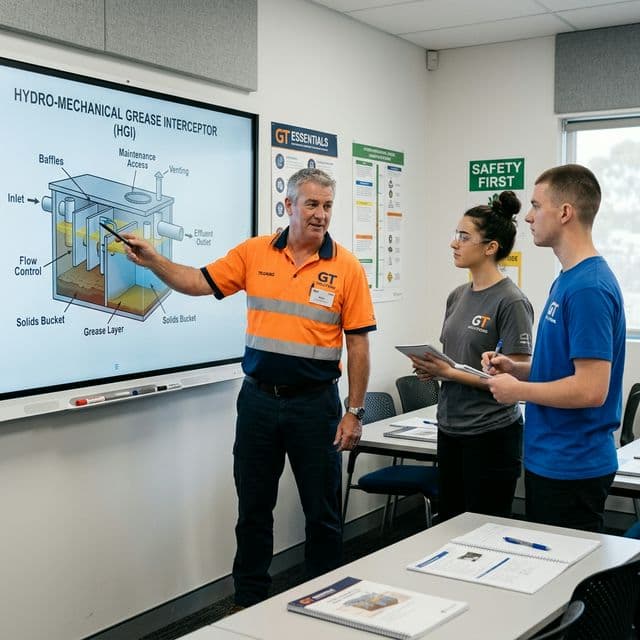
If the trap is undersized, the high-velocity water rushes straight through the baffles, carrying the emulsified fats, oils, and grease directly into the city sewer. This results in immediate environmental contamination and guarantees a failed municipal inspection. The pumping operator is often the first to recognize this failure, observing extreme grease carryover in the outlet pipes.
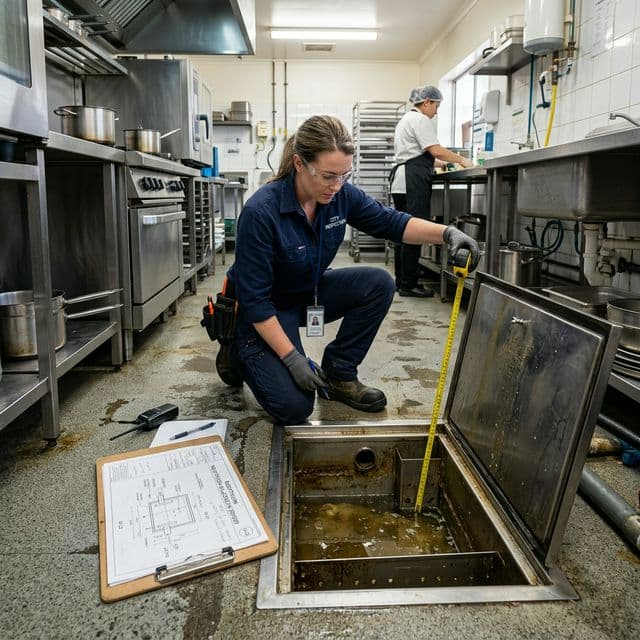
When an operator identifies an undersized trap, the AI platform allows them to document the exact dimensions and DFUs in the client portal. This data provides the restaurant owner with hard mathematical evidence that their infrastructure is inadequate, shifting the liability away from the pumping company and protecting them from blame when the trap inevitably causes issues.
The Impact on Pumping Frequency
An undersized grease trap requires drastically increased pumping frequencies to maintain compliance with the twenty-five percent rule. DispatchNode utilizes historical volume data to automatically calculate the hyper-accelerated pumping schedule required for an undersized trap, ensuring the restaurant avoids municipal fines without requiring the dispatcher to manually monitor the account.
A one-thousand-gallon interceptor in a standard restaurant might require quarterly pumping. If that same restaurant expands its menu to include heavy frying but fails to upgrade the trap, the existing interceptor will reach twenty-five percent capacity in a matter of weeks. The standard quarterly schedule becomes dangerously obsolete.
The AI routing engine solves this by tracking the burn rate of the trap's capacity. When the driver records the volume of FOG extracted during a service, the system analyzes how quickly the grease accumulated since the last visit. If the software determines the trap is accumulating grease too rapidly, it automatically pulls the next service date forward, modifying the recurring schedule from quarterly to monthly, or even weekly.
This automated schedule adjustment is a massive value proposition for the restaurant owner. They do not have to monitor their undersized trap; the software handles the compliance risk entirely. It also generates significantly higher recurring revenue for the pumping company, converting a standard quarterly client into a highly lucrative monthly stop.
Indoor Point-of-Use vs. Outdoor Interceptors
Commercial kitchens utilize two fundamentally different types of grease management: small indoor hydromechanical traps and massive outdoor gravity interceptors. DispatchNode segregates these asset types within the scheduling database, recognizing that a thirty-gallon under-sink trap requires a vastly different service frequency and routing profile than a two-thousand-gallon concrete interceptor.
Small indoor traps, often located directly under the three-compartment sink, have extremely limited holding capacities. They are highly prone to overflowing and producing severe odors within the kitchen environment. These point-of-use traps frequently require bi-weekly or monthly service to remain compliant. The dispatch system routes smaller, highly maneuverable service trucks to handle these high-frequency urban stops.
Conversely, outdoor gravity interceptors hold massive volumes of wastewater and FOG. They require heavy-duty vacuum trucks capable of pumping thousands of gallons. The software ensures that dispatchers never assign a small service truck to pump a massive outdoor interceptor, preventing the driver from arriving on-site only to realize their tank lacks the capacity to complete the job.
By clearly delineating asset types and sizes in the database, the operator can optimize their entire fleet. Large vacuum trucks are dedicated to highly dense, large-volume commercial routes, while smaller, more fuel-efficient vehicles are dedicated to the high-frequency indoor trap routes. This meticulous asset management drives massive margin improvements across the board.
Consulting and Upselling Infrastructure
Armed with precise data on trap sizing and flow rates, a pumping company transcends the role of a simple vendor and becomes an expert compliance consultant. DispatchNode empowers operators to generate detailed infrastructure reports that prove a client requires a larger grease trap, providing the leverage needed to sell highly lucrative installation and upgrade services.
When the software identifies a restaurant that requires bi-weekly pumping simply because their trap is vastly undersized, it highlights an opportunity. The operator can approach the restaurant owner with a clear financial calculation: "You are spending five thousand dollars a year on high-frequency pumping because your trap is too small. If we install a proper one-thousand-gallon outdoor interceptor, your pumping costs will drop by seventy percent."
This consultative approach builds immense trust. The restaurant owner recognizes that the pumping company is looking out for their long-term financial interests, rather than simply milking them for frequent service calls. The operator secures a massive, high-margin installation contract, and upon completion, retains the long-term quarterly pumping contract for the new trap.
By utilizing DispatchNode to master the mathematics of grease trap sizing, operators gain total control over their clients' FOG compliance. They prevent catastrophic overflows, optimize their routing frequencies, and uncover highly lucrative infrastructure upgrade opportunities, cementing their position as the undisputed market leader in commercial plumbing logistics.
Operational Benchmarks for Interceptor sizing calculations
| Metric | Industry Average | Best-in-Class Target | Impact |
|---|---|---|---|
| Response Time | 4-8 hours | Under 90 minutes | Captures premium emergency revenue |
| First-Call Resolution | 65% | 92%+ | Eliminates costly return visits |
| Route Efficiency | 4-5 stops/day | 7-9 stops/day | Maximizes technician productivity |
| Contract Retention | 70% annual | 94%+ annual | Compounds recurring revenue |
The EPA provides regulatory guidelines that directly impact operational benchmarks for grease trap service companies. Meeting these benchmarks consistently requires purpose-built dispatch software, not generic field service tools.
Automated Service Workflow
The automation eliminates manual coordination overhead, allowing the dispatcher to focus on exception handling rather than routine scheduling.
Best Practices
- Proactive Scheduling: Use AI-predicted pump cycles based on historical grease accumulation data rather than fixed calendar intervals.
- Digital Documentation: Generate digital manifests and compliance reports automatically after every service visit.
- Customer Communication: Send automated service reminders and completion confirmations via SMS.
- Performance Tracking: Monitor technician efficiency metrics including stops per day, average service time, and customer satisfaction scores.
- Regulatory Compliance: Maintain a digital compliance database that can be exported for health department or municipal inspections on demand.
For a related analysis, read our guide on FOG Compliance Regulations.
Volumetric Flow Dynamics and Retention Time
The fundamental science of grease interceptor sizing is governed by the principles of volumetric flow dynamics and hydraulic retention time. An interceptor does not magically destroy grease; it relies entirely on gravity and time. For the physical separation of Fats, Oils, and Grease (FOG) to occur, the turbulent, hot wastewater exiting the commercial kitchen must be slowed down and allowed to cool. The FOG, which has a lower specific gravity than water, requires a specific duration of absolute calm to rise to the surface and congeal.
This required duration is known as the "hydraulic retention time," and it is the critical metric in interceptor sizing. In a properly engineered system, the retention time must exceed thirty minutes during peak flow conditions. If a restaurant installs an undersized interceptor—perhaps opting for a five-hundred-gallon tank to save upfront capital costs when the engineering math dictates a fifteen-hundred-gallon tank—they drastically reduce the retention time.
During the Friday dinner rush, when the three-compartment sinks are continuously draining and the commercial dishwashers are cycling rapidly, the flow rate into the undersized interceptor skyrockets. The turbulent water moves through the small tank so quickly that the retention time drops to less than ten minutes. The hot, emulsified grease never has the opportunity to cool and separate. It simply blows straight through the baffle system and discharges directly into the municipal sewer main.
When this hot grease hits the cooler municipal pipes, it immediately congeals, adhering to the pipe walls. Over months, this buildup creates a massive "fatberg" that eventually causes a complete sanitary sewer overflow (SSO). Municipal water authorities investigate these SSOs by tracing the blockage upstream, inevitably leading them directly to the restaurant with the undersized interceptor. The resulting municipal fines, mandated emergency upgrades, and potential operational shutdowns dwarf the money the restaurant initially saved by purchasing the smaller tank.
Algorithmic Sizing and Menu Impact Modeling
Calculating the precise required capacity of a grease interceptor is a complex engineering task that cannot be solved with simple rules of thumb. Many inexperienced plumbers or restaurant owners attempt to size a trap based solely on the total seating capacity of the restaurant. While seating capacity is a factor, it is a profoundly incomplete metric that fails to account for the most critical variable: the specific culinary profile of the establishment.
A two-hundred-seat sushi restaurant produces a fraction of the FOG generated by a two-hundred-seat fried chicken franchise or a high-volume steakhouse. Relying on generic seating formulas guarantees catastrophic sizing errors.
Advanced FOG consulting and dispatch platforms utilize algorithmic sizing models that incorporate complex "Menu Impact Variables." When proposing a preventative maintenance contract or consulting on a new restaurant build-out, the software requires the input of detailed operational parameters. It calculates the total Drainage Fixture Units (DFUs) by aggregating the flow rates of every connected appliance—three-compartment sinks, mop sinks, pre-rinse stations, and floor drains.
Crucially, the algorithm then applies a multiplier based on the menu classification and the presence of specific equipment, such as deep fryers or wok stations. It also factors in the hours of operation and the anticipated peak meal volumes. By running these variables through a rigorous fluid dynamics model, the software generates a scientifically sound capacity recommendation.
For the FOG operator, utilizing this advanced sizing software serves a dual purpose. First, it protects the client from regulatory disaster by ensuring their infrastructure can actually handle their specific volume of FOG. Second, it establishes the operator as an authoritative, engineering-focused consultant rather than a mere waste hauler. When an operator can present a mathematically proven sizing model to a restaurant group or general contractor, they win the long-term maintenance contract based on unmatched technical expertise.
The engineering report generated by the sizing algorithm is frequently utilized beyond the initial sales pitch. General contractors rely on these certified FOG reports to secure their final municipal plumbing permits. By providing this highly technical documentation as a standard component of the consultation, the FOG operator cements their status as an integral, indispensable partner in the commercial construction process.
The integration of the capacity sizing algorithm into the operator's initial sales process serves as a powerful mechanism for establishing unquestionable technical authority. When a restaurant owner requests quotes from three different FOG operators for a new location build-out, two competitors will likely provide a flat price based on a superficial phone conversation. The sophisticated operator utilizes the algorithmic sizing tool. The sales representative arrives on-site with a tablet, walks the kitchen with the owner, and inputs the exact DFU flow rates of every appliance. The software instantly generates a detailed, multi-page engineering report, visually mapping the hydraulic flow and mathematically proving why a fifteen-hundred-gallon tank is required instead of the thousand-gallon tank proposed by the competitors. This level of rigorous, data-backed analysis obliterates the competition. The restaurant owner realizes that choosing the cheaper, undersized option is a guaranteed path to catastrophic municipal fines, ensuring the sophisticated operator wins the high-margin installation and long-term maintenance contract.